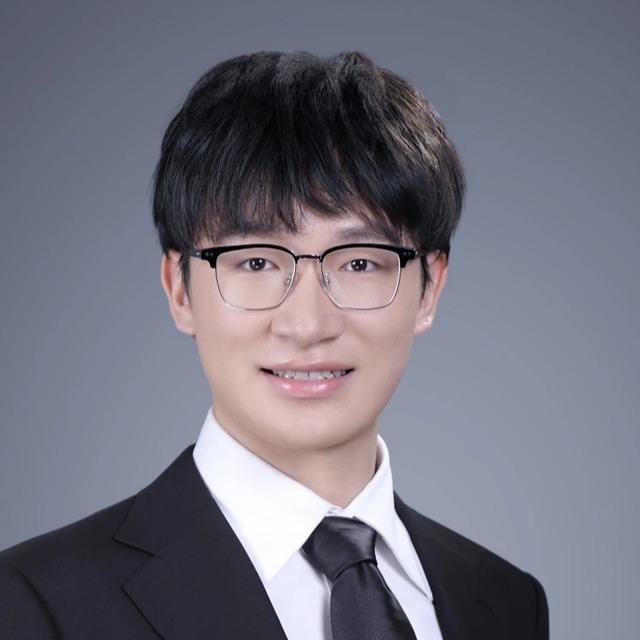


Zhengshen ZHONG (钟政燊)
Nice to meet you! I’ve been admitted by recommendation to the Management Science and Engineering master’s program at Shenzhen University’s School of Management.
My interests center on AI applications and intelligent decision-making in management science: federated learning, multi-agent collaboration, and large language model applications.
I welcome related discussions and collaborations. Chinese CV · English CV · GitHub
Research Interests & Selected AI Projects
In management science and engineering, I apply AI to data analysis, knowledge discovery, and management decisions.
- Artificial intelligence applications: federated learning, multi-agent collaboration, large language models, and knowledge discovery.
- Intelligent decision-making: data-driven prediction, risk identification, and decision support.
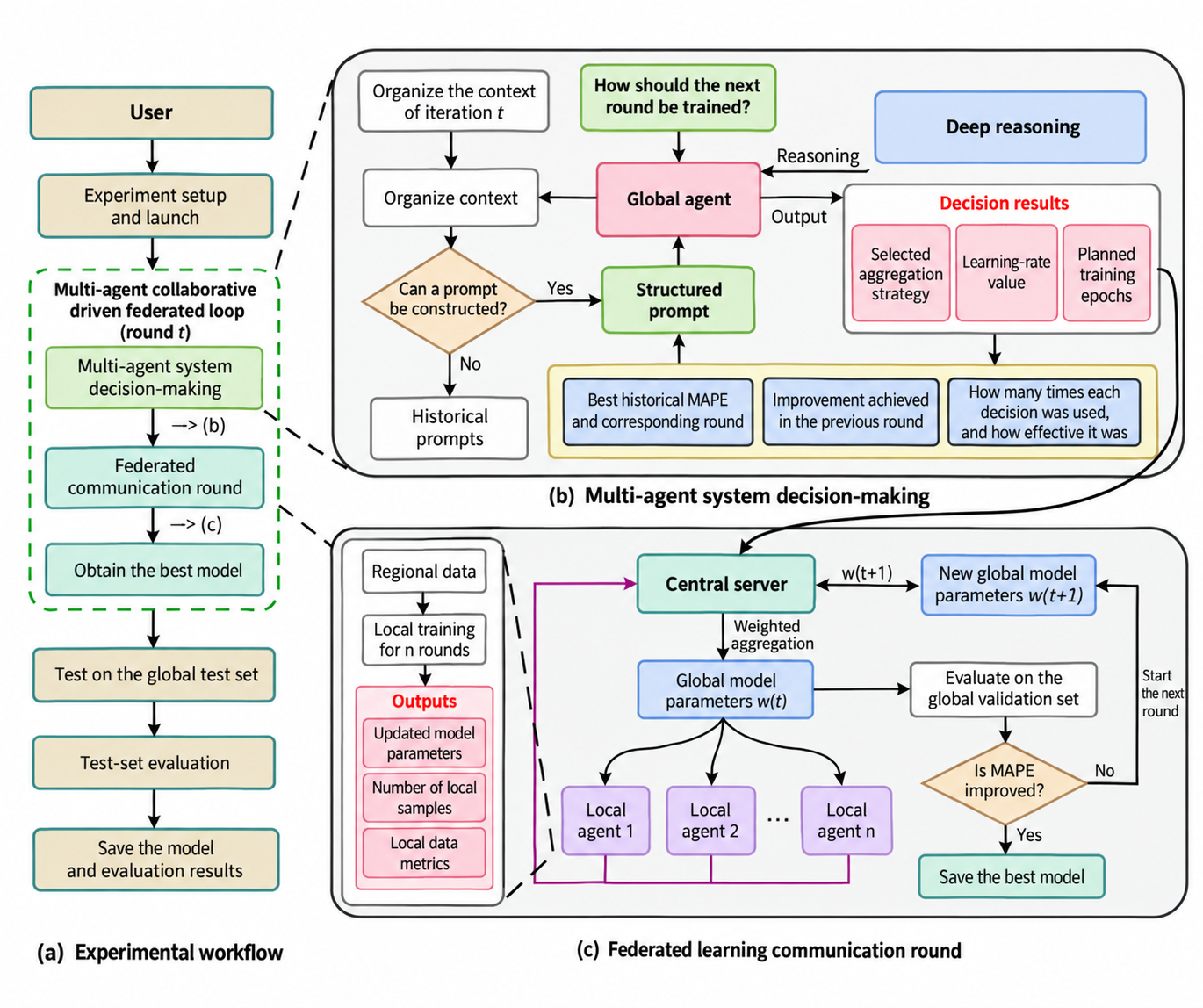
Agent-Augmented Federated Learning for Cost Estimation
View full project showcase (Chinese)
Explore project details
Background: Cost data are distributed across regions, while privacy constraints limit centralized sharing and model generalization. This project investigates collaborative prediction without exchanging raw data.
- Data preparation and federated modeling (3 clients): Processed Florida highway project data for missing values, outliers, and format consistency, then partitioned clients by region. Connected local training, parameter uploads, server aggregation, and model distribution while retaining raw data locally.
- Multi-agent coordination and dynamic aggregation: Used LLM-based agents for state monitoring, strategy decisions, and training control. Client losses and prediction errors inform aggregation weights and training strategies, feeding each round’s results into the next optimization step.
- Experimental evaluation: Compared cross-region cost predictions with FedAvg using MAPE and other error measures. Examined client and global-model performance through a workflow that records trained models, training logs, and evaluation outputs.
Outcomes: **Achieved **6.81% lower MAPE than FedAvg, supporting privacy-preserving cost estimation across regions.
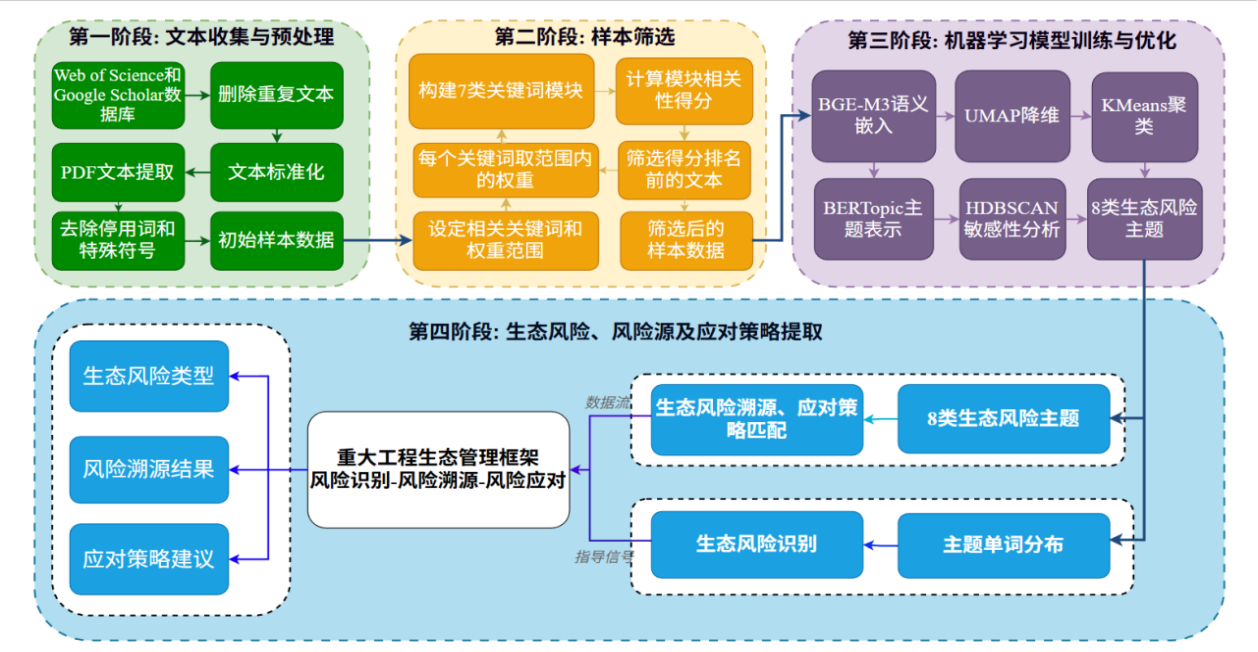
Deep Representation Learning for Ecological Risk Topic Modeling
View full project showcase (Chinese)
Explore project details
Background: Ecological-risk information in major projects is fragmented, with inconsistent identification criteria and limited evidence for classification. The project uses deep representations to discover risk knowledge from literature.
- Semantic representations and topic modeling: Encoded ecological-risk literature with BGE-M3, reduced dimensions with UMAP, clustered with KMeans, and extracted topic keywords with BERTopic to turn fragmented text into interpretable risk themes.
- Model validation: Cross-checked topic assignments with LDA, HDBSCAN sensitivity analysis, and manual review of representative documents, identifying eight risk themes with evidence-supported interpretations.
- Evidence tracing and decision support: Connected risk themes, engineering disturbances, ecological receptors, and governance strategies in 24 traceable evidence chains, organizing the findings into an identification, tracing, and response framework.
Outcomes: **Identified **8 risk themes and built 24 evidence chains. The paper has been accepted by Journal of Guangzhou University.
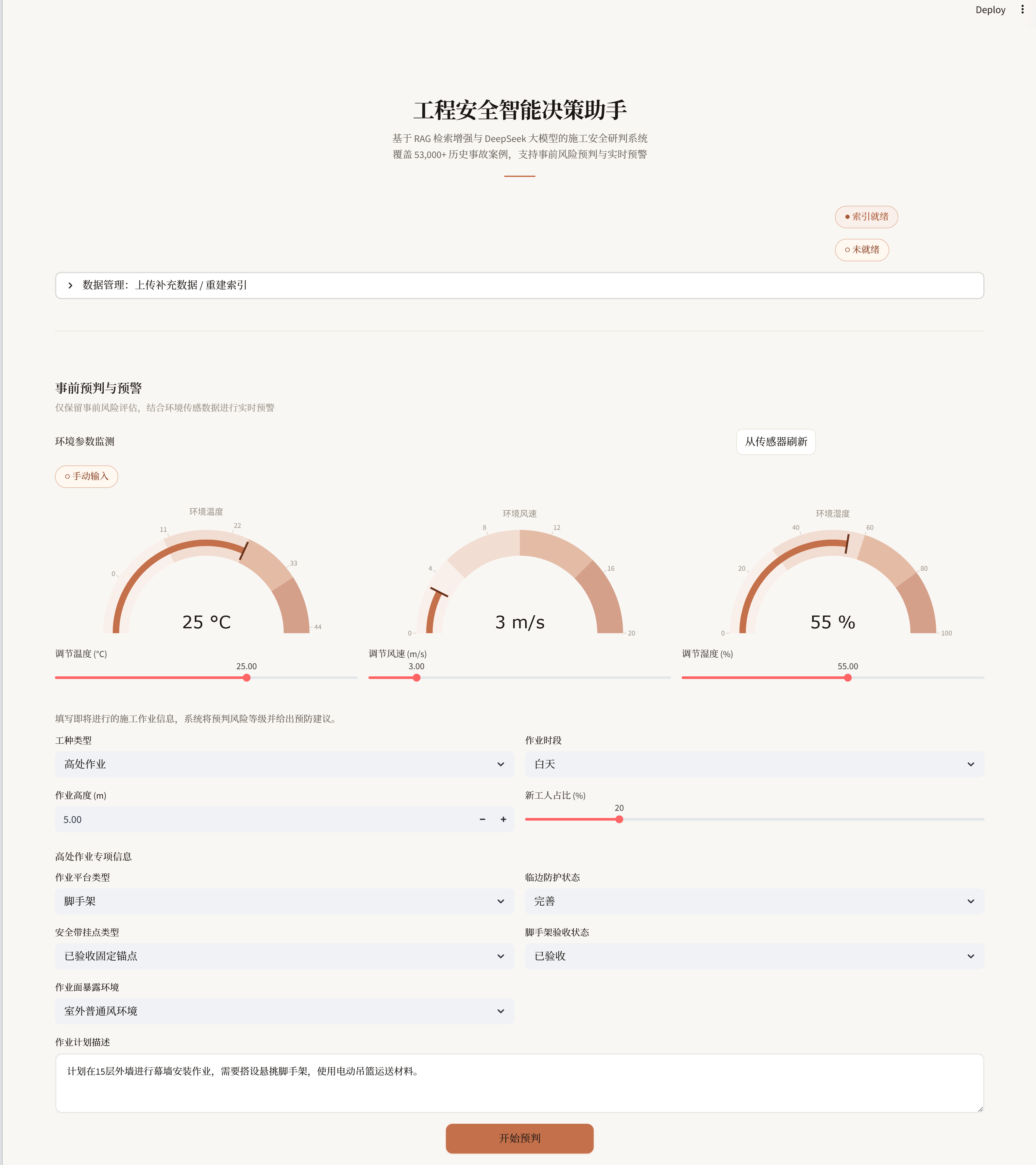
Construction Safety Risk Analysis with RAG and LLMs
View full project showcase (Chinese)
Explore project details
Background: Conventional project operations face delayed risk identification, rigid resource allocation, and limited knowledge reuse. As a core member of a university innovation project, I developed the intelligent operations platform.
- Knowledge bases and vector retrieval: Organized 53,550 accident records into a construction-safety knowledge base, using embedding models and FAISS indexes to retrieve relevant historical cases for a given task.
- RAG and LLM reasoning: Combined hybrid retrieval with LLM reasoning, evidence constraints, and output validation to generate traceable risk levels, hazard descriptions, and preventive recommendations.
- Platform development: Developed the operations platform, connecting task inputs, environmental monitoring, proactive assessment, structured reports, and historical-case queries to support cost, schedule, and safety decisions.
Outcomes: **Delivered the platform and completed the project. Results reported in the CV include **15% higher risk-identification accuracy and a 20% improvement in the cost-benefit ratio of resource allocation.
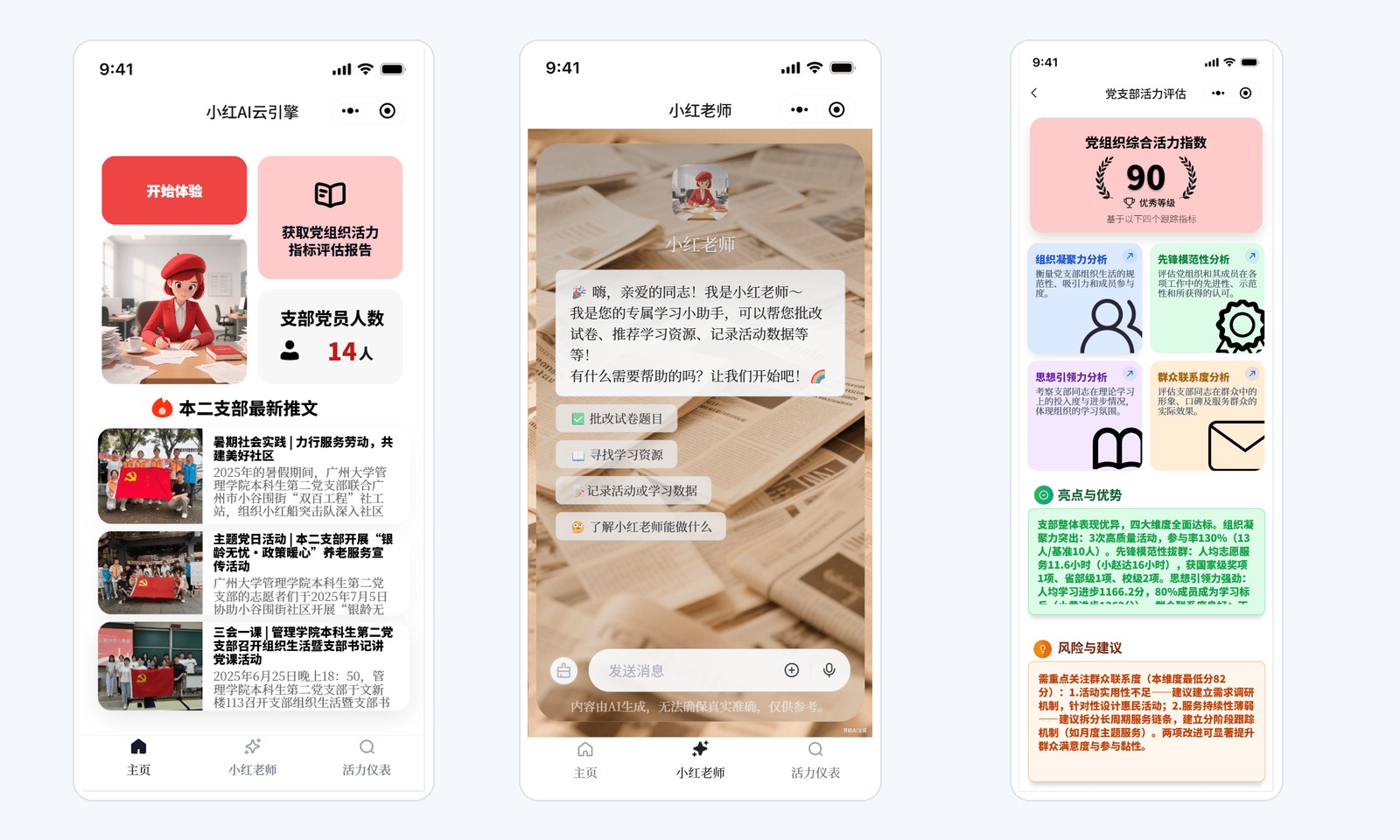
Personalized Learning and Team Vitality Assessment Mini Program
View full project showcase (Chinese)
Explore project details
Background: Built a WeChat Mini Program for personalized learning and team-vitality assessment, connecting user profiles, recommendations, and organizational evaluation.
- Requirements and prototyping: Led requirements research, feature planning, and software prototyping for learning recommendations and vitality assessment.
- Agent workflows and prompt engineering: Built five Coze agent workflows and over 40 structured prompts for recommendations, conversational learning, and automated assessments.
- End-to-end development: Connected the front end, back end, and agent workflows and deployed the WeChat Mini Program.
Outcomes: **Launched the Mini Program and won a **National Second Prize in the College Student Digital Media Technology Competition as team lead.
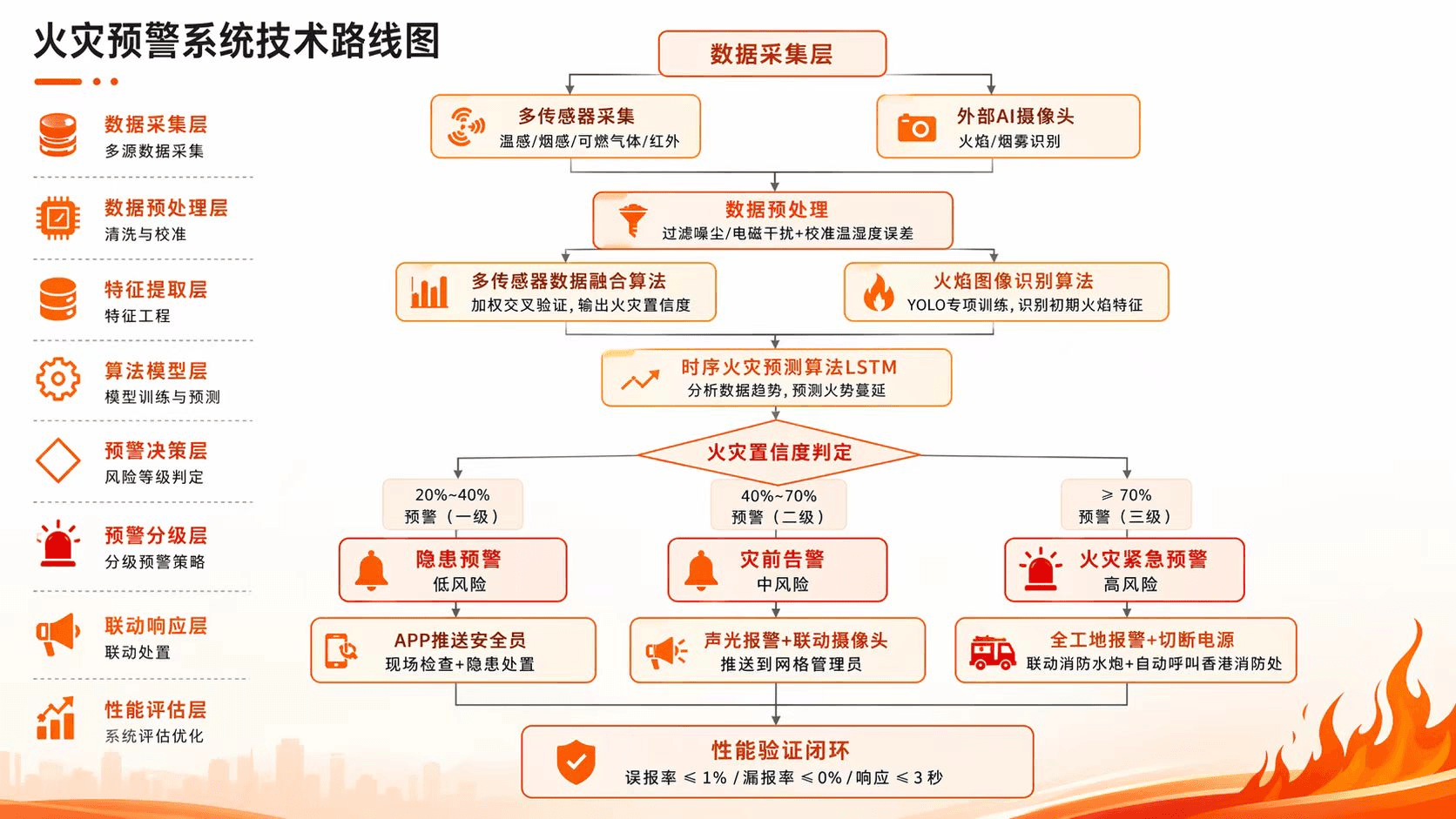
Intelligent Construction Fire Warning Based on Inherent Safety
View full project showcase (Chinese)
Explore project details
Background: Hot work, combustible materials, and personnel movement create interacting construction-site risks. This proposal translates inherent-safety principles into preventive fire-risk management.
- Safety workflow design: Designed three layers—risk isolation, process control, and sensing and warning—connecting permits, safety checks, and site monitoring.
- AI-assisted prototyping: Used tools including Claude Code to build an interactive system demo and organize risk-response flows.
- Technical and multimedia communication: Combined a technical roadmap, site visuals, and videos to communicate the vision, sensing, and warning proposal.
Outcomes: **Delivered an interactive **three-layer control demo, a technical roadmap, videos, and a poster. Simulated data illustrate the response workflows.
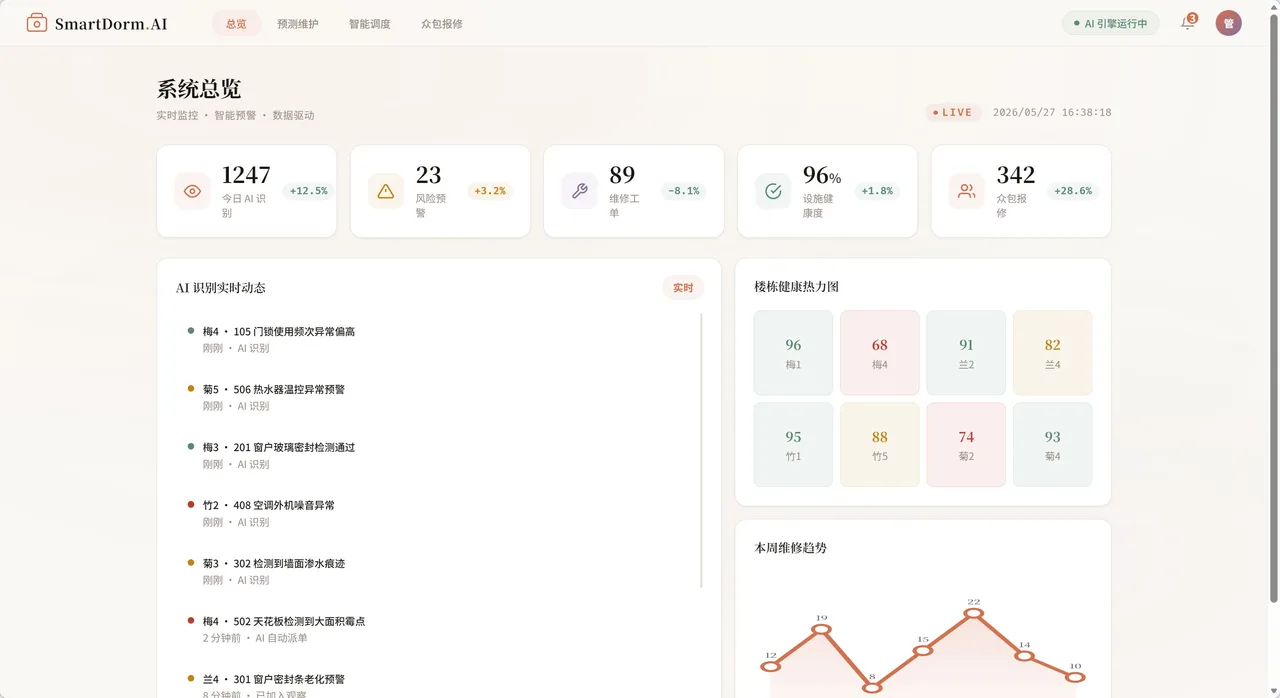
SmartDorm.AI · AI-Assisted Dormitory Operations
View full project showcase (Chinese)
Explore project details
Background: Slow maintenance responses, weak issue tracking, and low student participation motivate an AI-assisted dormitory operations prototype linking reports, dispatch, and maintenance.
- Requirements and product design: Organized four modules around students, managers, and maintenance staff: dashboard, predictive maintenance, dispatch, and crowdsourced reporting.
- Operations and dispatch workflows: Incorporated work orders, staff locations, and materials into workflows for route planning, task grouping, and maintenance prioritization.
- Interactive front-end development: Built a navigable demo with building-health maps, risk indicators, and reporting interfaces.
Outcomes: **Delivered an interactive prototype with **four functional modules, demonstrating the workflow from student reporting to management dispatch.
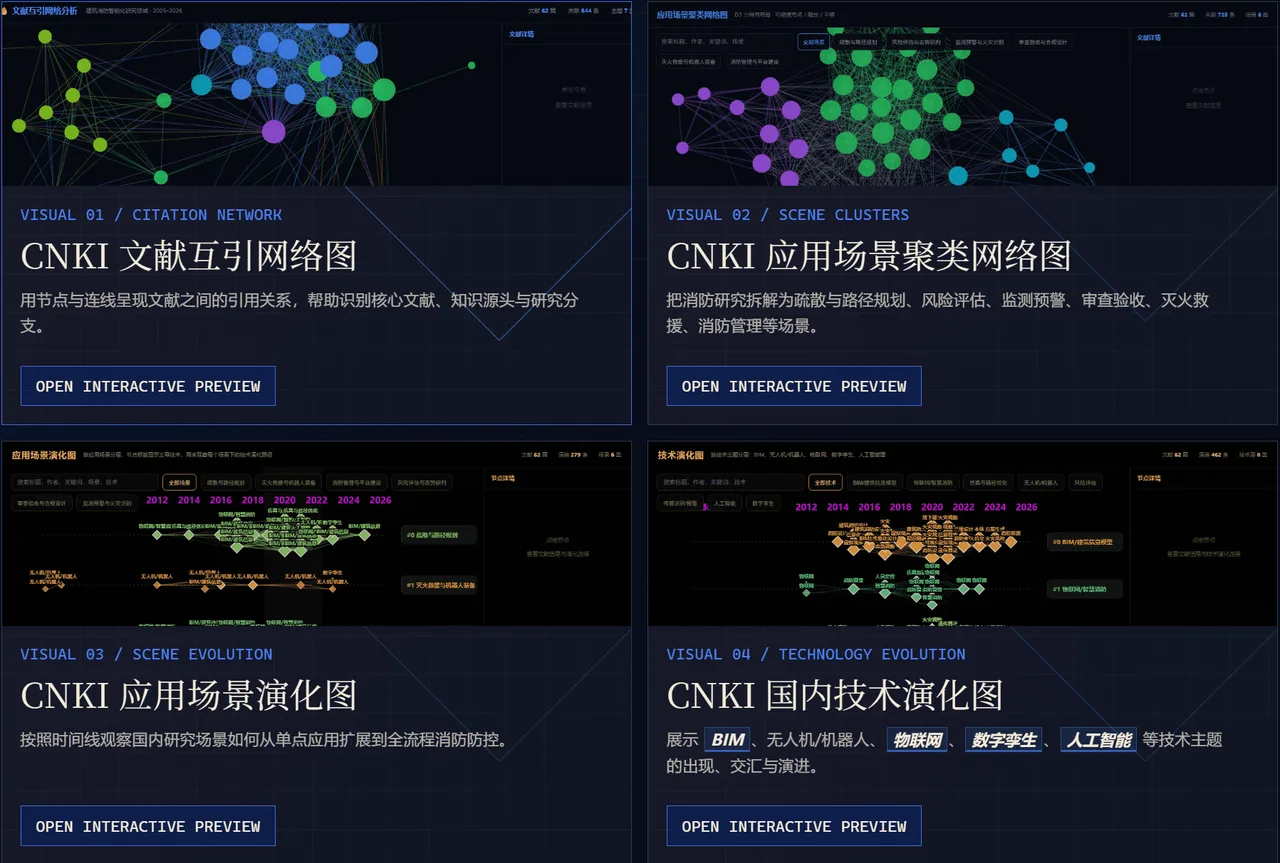
Interactive Literature Analysis for Smart Construction and Fire Safety
View full project showcase (Chinese)
Explore project details
Background: The project organizes literature relationships, application scenarios, and technology evolution in smart construction and building fire safety into an explorable research presentation.
- Literature synthesis: Organized CNKI citation relationships, application clusters, and technology evolution to reveal connections across studies.
- Interactive data visualization: Presented literature relationships as network and evolution diagrams for visual exploration.
- Web-based research communication: Integrated diagram previews, interactive pages, and presentation materials into a browsable project site.
Outcomes: **Delivered **four interactive visualizations covering citation networks, application clusters, application evolution, and domestic technology evolution.
Experience
Shenzhen University, Shenzhen, China
Sept. 2027 - Jul. 2030 (Expected)
Incoming Master’s Student in Management Science and Engineering
School of Management
Admitted through postgraduate recommendation.Guangzhou University, Guangzhou, China
Sept. 2023 - Jul. 2027
Undergraduate Studies in Engineering Management
School of Management
GPA: 3.90/4.00; Rank: 1/101 (first five semesters)
Minor: Metaverse Intelligent Decision-Making and Human-Computer Interaction
Selected coursework: Operations Research, Management, Python Programming, Database Fundamentals, Probability and Mathematical Statistics, and BIM Technology.The University of Hong Kong, Hong Kong, China
Jul. 2026 - Aug. 2026
Visiting Program in AI and Robotics
Studied computer vision, SLAM-based autonomous navigation, and large models for humanoid robots; visited SenseTime and other technology companies.Huayan Robotics, Shenzhen, China
Nov. 2026 - Present
Supply Chain Management Intern
Support supply chain transformation and process improvement. Designed and deployed an internal talent-discovery survey using WorkBuddy to support employee capability assessment and talent identification. Develop AI training courses for executives, covering practical tools and workflows in business contexts to help leaders use AI effectively.Tongwang Technology Co., Ltd., China
Jul. 2026 - Sept. 2026
Product Assistant Intern
Supported highway cost-estimation software iteration and competitor research. Standardized 40,000+ quota records into Excel and HTML formats for software development, and automated file conversion and validation workflows with Codex.
Research
Bridging Data Silos in Cost Estimating: An Agent-Augmented Federated Learning Approach
First author
Sept. 2025 - Aug. 2026
Developed a horizontal federated-learning setting using Florida highway project data and three collaborating clients. Introduced a multi-agent aggregation mechanism that adjusts client weights based on training states. Experiments reported a 6.81% reduction in MAPE relative to FedAvg.Deep Representation Learning for Ecological Risk Topic Modeling in Major Engineering Projects — Accepted by Journal of Guangzhou University
Core researcher; National Undergraduate Innovation Project
Jun. 2025 - May 2026
Built a BGE-M3–UMAP–KMeans–BERTopic pipeline to analyze ecological-risk literature. Conducted LDA benchmarking, HDBSCAN sensitivity analysis, and manual review; identified eight risk themes and established 24 traceable evidence chains for risk identification, source tracing, and governance.AI-Enabled Refined Operations and Maintenance Management for Engineering Projects
Core researcher; University Undergraduate Innovation Project; completed
Jun. 2025 - Mar. 2026
Developed an intelligent operations and maintenance platform using embedding models, FAISS, and RAG. Built a construction-safety knowledge base from 53,550 accident records, with hybrid retrieval, evidence constraints, and output validation to support traceable risk assessment.
[Code]
Honors and Awards
National Scholarship (sole recipient in Engineering Management, School of Management), Guangzhou University
Sept. 2026Second Prize (National; Top 8%; Team Lead), National College Student Digital Media Technology Works and Creative Competition
Oct. 2025 [Evidence]Second Prize (National; Top 8%), National College Business Elite Challenge — Accounting and Business Management Case Competition
Jun. 2024 [Evidence]Third Prize (National; Top 10%), 15th National College Student Market Survey and Analysis Competition
May 2025 [Evidence]First Prize (Guangdong Province; Top 5%; Team Lead), 16th National College Student Market Survey and Analysis Competition
Apr. 2026 [Evidence]Bronze Award (Guangdong Province; Team Lead), National College Student Career Planning Competition
Mar. 2026 [Evidence]First-Class University Scholarship (Top 5%), Guangzhou University
Nov. 2025 [Evidence]Outstanding Student; Outstanding Youth League Member and Student Leader; School of Management Top Ten Student, Guangzhou University
2024–2026 [Evidence]Outstanding Volunteer, Opening Ceremony of the 15th National Games
Dec. 2025 [Evidence]
Skills
- Engineering and Development: Python, C/C++, PyTorch, Hugging Face, MS-SWIFT, FastAPI, SQLite, Docker, Git, Vue 3, and Linux
- AI-Assisted Development: Intensive daily use of Codex and Claude Code, consuming on the order of 10 billion tokens per month
- Documents and Media: LaTeX, Markdown, MS Office/Visio, Adobe Photoshop, and Premiere Pro
- Data Analysis and Management Research: Pandas, Scikit-learn, SPSS, text mining, regression analysis, structural equation modeling, financial forecasting, and sensitivity analysis
- Languages: CET-6: 452; CET-4: 484
Learning is one of life’s greatest joys.
I enjoy films, music, photography, football, running, badminton, hiking, and cooking…
Leadership and Service
- Served as class monitor and head of a student association’s academic department, organizing activities with more than 100 participants.
- Participated in three rural social-practice programs, with outcomes covered by news media.
- Contributed 341+ hours of volunteer service, including service at the opening ceremony of the 15th National Games.